
productivity
implementation
The One-Thing Rule: Why the Entrepreneurs Who Get the Most Done Do the Least at Once
January 2018.
I'm standing in front of about thirty entrepreneurs at one of our monthly marketing meetings in San Diego. Smart people. Motivated people. Every one of them showed up on their own time to learn how to grow their business.
I asked them to do one thing before the next meeting.
Not rebuild their funnel. Not launch a new campaign. Not implement an AI workflow.
One thing: run a single split test on their website. Change one headline. Measure the result. That's it.
Every hand went up. "I'm in."
Next month, same room, I asked who'd done it.
Dead silence. Not one person out of thirty.
Thirty motivated entrepreneurs who showed up voluntarily, agreed to do one simple thing, had all the tools and knowledge they needed, and had an entire month to do it. Zero implementation.
That moment crystallized something I'd been watching for years: the problem isn't that entrepreneurs can't do things. It's that they're trying to do everything. And "everything" produces "nothing" with remarkable consistency.
The Everything Trap
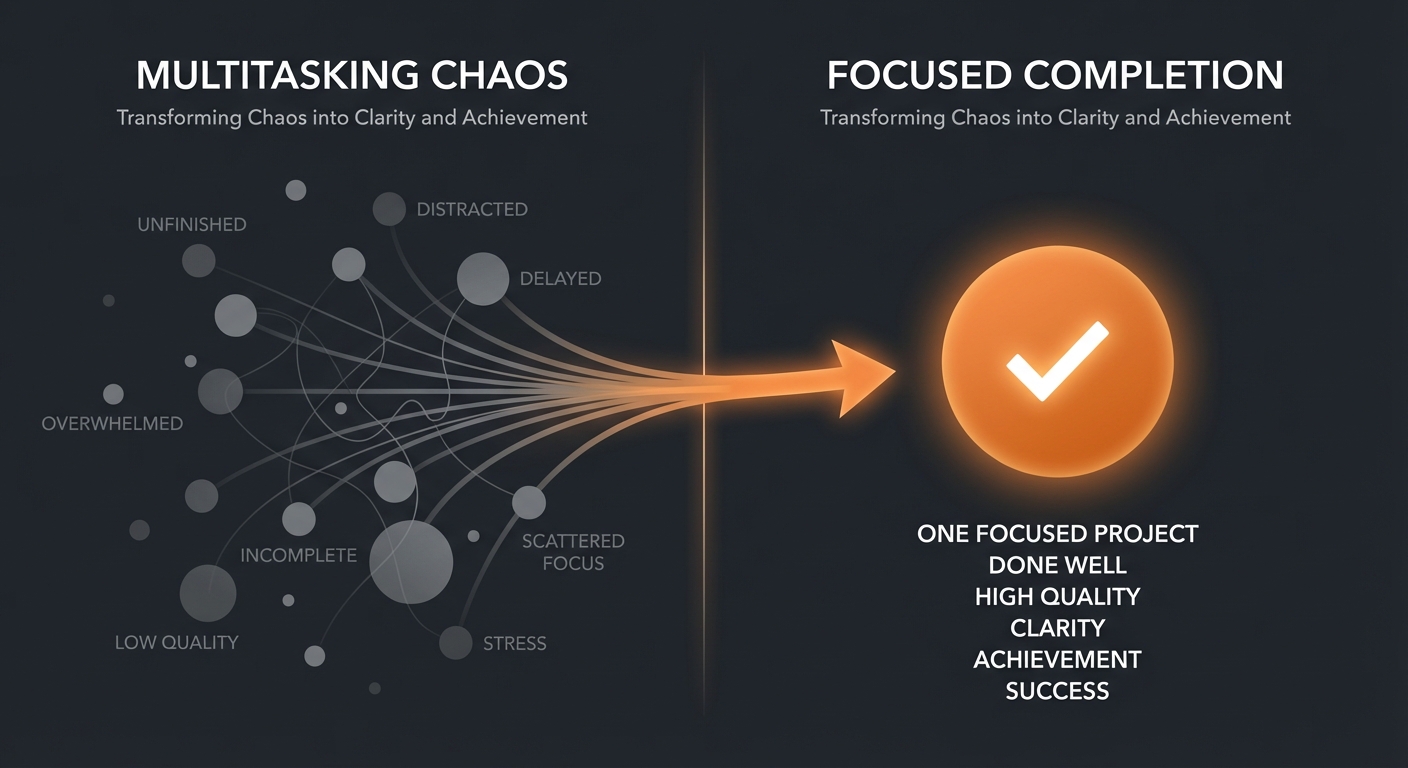
Here's what that month actually looked like for the people in that room. They went home Monday night, energized from the meeting. By Tuesday morning, they had eleven emails that needed responding to, a client fire, and a team member waiting for a decision. The split test - the one thing - got added to a list. A list that already had 30 items on it. By Wednesday, it had been reprioritized below three other "urgent" tasks. By Friday, it was functionally invisible.
Not because they forgot. Not because they didn't care. Because it was competing with everything else for a sliver of attention that didn't exist.
This is the pattern I've watched repeat for 24 years across hundreds of businesses. The entrepreneur doesn't have an ambition problem. They have a focus problem. Specifically: they treat every project as equally important, which means none of them get the concentrated attention required to actually finish.
Your to-do list is proof. Open it right now. Count the projects. Not the tasks within projects - the distinct initiatives you're supposedly working on simultaneously. If the number is under five, you're unusual. If it's between ten and twenty, you're normal. If it's over twenty, you're not behind on your projects. Your projects are behind on getting your attention.
That's not a discipline issue. That's a math issue. There are 168 hours in a week. Subtract sleeping, eating, commuting, family, client work, team management, email, meetings, and the daily fires you didn't plan for. What's left for strategic project work? For most entrepreneurs I talk to, it's somewhere between 3 and 8 hours per week. Try spreading 3 hours across 15 projects and see what finishes. Nothing finishes. Everything moves an inch. And moving an inch doesn't produce results - it just produces the illusion of progress while the list gets longer.
Why Your Brain Wants to Work on Everything at Once
Understanding why you do this is important, because the trap is self-reinforcing and it feels productive even when it isn't.
Starting feels like finishing. Your brain rewards novelty. Opening a new project, sketching out the plan, doing the first 20% of the work - that's the exciting part. It triggers the same reward chemicals as actually completing something. So you get the dopamine hit of "I'm making progress" without ever reaching the finish line. Then a new idea comes along, and the cycle starts again because starting the new thing feels better than grinding through the unglamorous middle of the current one.
Switching feels like flexibility. When you bounce between projects, it feels like you're being responsive and adaptive. "I'm juggling a lot" sounds like a strength in entrepreneur culture. But there's a real cost to every switch: it takes an average of 23 minutes to regain deep focus after a context switch. If you're switching between three projects in a day, you're burning over an hour just getting your brain back to where it was. That's not flexibility. That's friction disguised as productivity.
Your list is a security blanket. Here's the one nobody talks about. The massive to-do list makes you feel like you're on top of things - like at least you know what needs to happen, even if you can't do it all. Cutting the list down to one thing feels reckless. What about the other 14 projects? They'll fall behind. Clients will notice. Opportunities will be missed. So you keep the full list because it manages your anxiety, even though it's the source of your anxiety. (This connects directly to why perfectionism stalls your projects - the fear of choosing wrong keeps you from choosing at all.)
The environment enables it. Nobody in your life is telling you to do less. Your team brings you new priorities daily. Your inbox generates new tasks hourly. Every podcast, newsletter, and LinkedIn post suggests one more thing you should be doing. The entire ecosystem around an entrepreneur is designed to add items to the list, and nothing in that ecosystem is designed to remove them.
The One-Thing Rule
Here's the rule, and it's deceptively simple: pick one project. Work on it until it's done or until you've reached a clear stopping point. Then pick the next one.
Not one project per category. Not "one thing plus the three things I'm maintaining." One project that gets your implementation energy this week.
Everything else goes on a list called "Not Yet." Not "Someday Maybe." Not "Backlog." "Not Yet." Because you're not abandoning those projects. You're sequencing them. The Not Yet list is a queue, not a graveyard.
I've been teaching this for years. It's the single most repeated piece of advice across every training, every meeting, every conversation I've had with business owners. And I can tell you that the people who actually follow it - who pick one thing and refuse to get pulled into the other fourteen - outperform the multitaskers by a margin that's almost embarrassing.
What "One Thing" Looks Like in Practice
One business owner attended my monthly marketing meetings for years. She'd hear strategies, take notes, get excited. Then she'd go home with a list of eight things to try and implement none of them, because she was planning something bigger and more polished for each one.
Then one month, she just did it. She picked one small thing I'd taught - setting up a local business offer on a free platform. Nothing fancy. Nothing polished. She didn't wait until she had the perfect campaign built. She just did the one thing.
The result: 2,200 impressions and 20 customer actions. Completely free. One imperfect action, implemented in a fraction of the time she'd been spending planning the perfect version of eight actions that never happened.
Another entrepreneur had a similar experience from a different angle. He bought a marketing automation program. Got excited about it. But the program had multiple modules, multiple workflows, multiple things to set up. Faced with all of it, he did what most entrepreneurs do: nothing. He "didn't do a darn thing" with it for months. When I helped him set it up - not everything at once, but one piece at a time - results started coming in immediately. The difference wasn't knowledge. It wasn't motivation. It was that someone helped him break "implement the whole program" into "implement this one thing right now."
A third member of our group attended live marketing trainings and events for seven years. Seven years of accumulated knowledge. Strategies he could explain to anyone. But the implementation wasn't happening because every event added five more things to the list. When he finally got hands-on help and started executing one thing at a time, he said it "completely changed my whole business around." Same knowledge. Same person. Different approach: one thing, done, then the next thing.
The Compound Math of One Thing Per Month
Here's where the One-Thing Rule stops being a productivity tip and becomes a business strategy.
If you implement one meaningful project per month - not twelve things at 8% each, but one thing at 100% - here's what happens over a year.
Month 1: You build your email welcome sequence. It starts converting leads into customers while you sleep.
Month 2: You document your client onboarding process and hand it to your team. You never do onboarding yourself again. You just freed up 3 hours per week.
Month 3: You set up a split test on your main landing page. Your conversion rate improves by 25%. Same traffic, more customers.
Month 4: You build an automated follow-up sequence for leads who didn't buy. Revenue from "lost" leads starts appearing.
Month 5: You document and delegate your weekly reporting. Another 2 hours reclaimed per week.
Month 6: You build a custom dashboard that shows your real numbers in one place, replacing the three tools you were cobbling together.
That's six months. Six completed projects. Each one is producing results right now - generating revenue, saving time, or improving conversion - because each one was done completely before you moved to the next.
Compare that to the alternative: six months of working on all six simultaneously, each one 40% done, none of them producing any results because nothing is finished. Same amount of work. Dramatically different outcomes.
Now extend the one-thing approach to twelve months. Twelve completed implementations. Twelve systems working in your business. That's not incremental improvement. That's a fundamentally different business than the one you're running today. And it started with the discipline to say "this one, first, completely."
How to Pick the One Thing
This is where most people get stuck. The list has 20 items. They all feel important. How do you pick just one?
1. Start with the nagging one, not the exciting one.
Your brain wants to start with the shiny new project. The AI workflow. The new product launch. The rebrand. Ignore that impulse. Look at your list and find the project that's been sitting there the longest. The one that gives you a small pang of guilt every time you see it. The one you keep rescheduling.
That's your one thing. Not because it's the most impactful (though it might be), but because it's the one that's been eroding your confidence the longest. Finishing it breaks the cycle of incomplete projects. The psychological win of crossing off something that's haunted you for months is worth more than the marginal difference in business impact between that project and the "optimal" choice.
2. Apply the 90-minute test.
Could you make meaningful progress on this project in a single 90-minute session? If yes, it's the right size. If the project is so large that 90 minutes wouldn't even scratch the surface, it's not a project - it's a category. Break it down. "Rebuild my marketing funnel" is a category. "Write the headline and first section of my landing page" is a project you can finish in 90 minutes.
3. Ask: if this were done, what would change?
For each candidate on your list, ask what would be different in your business next month if this were completely finished. Some projects change everything: a working email sequence generates leads while you sleep. A documented process frees up five hours a week permanently. Other projects change very little: a prettier logo, a reorganized file structure, a slightly better dashboard layout. Pick the one where "done" creates the biggest downstream change.
4. Ignore urgency. Follow impact.
Urgency is a liar. The "urgent" project is usually someone else's priority, not yours. The client who needs a response today. The team member who needs a decision this afternoon. Those aren't your one thing - those are interruptions that get handled during business hours. Your one thing is the strategic project that never feels urgent but always matters: the system that would save you 10 hours a week, the optimization that would increase conversion by 20%, the documentation that would let your team operate without you. Urgency will always exist. Impact compounds.
5. Once you choose, commit publicly.
Tell someone what you're going to finish and when. Not "I'm working on my email sequence." A specific commitment: "By Friday at 5 PM, I will have my three-email welcome sequence written and loaded into my CRM." Text it to a friend, tell your spouse, post it in a community. The moment you make the commitment visible to another person, the odds of completion increase dramatically - not because of pressure, but because you've made the invisible visible. (I wrote about why this works in The Implementation Gap - accountability doesn't have to be complicated to be effective.)
The One-Thing Rule works. The math is simple, the proof is real, and you could start today by picking one project from your list and giving it your full attention this week.
But here's what I've watched happen hundreds of times: the entrepreneur picks the one thing, works on it Monday and Tuesday, and by Wednesday the daily chaos of running a business has pulled them back into reactive mode. By Friday, the one thing is right back on the list, 30% done, buried under everything else that demanded attention.
The rule is simple. Following it consistently, week after week, without someone in your corner - that's the hard part. And it's the exact part that the Implementation Club is designed to solve. You show up Thursday with your one thing. The time is already blocked. There's no inbox to check, no Slack to respond to, no "quick call" that pulls you away. You work on the one thing for the full session, with real-time support when you hit a wall.
Between sessions, the Slack community keeps you honest. You said you'd finish the welcome sequence by Thursday. Someone's going to ask how it went. Not in a guilt-trip way - in a "we're all building together" way. The accountability isn't manufactured. It's what naturally happens when you're surrounded by people who are also implementing one thing at a time and making visible progress every week.
Twelve months from now, you could have twelve completed implementations working in your business. Or you could have 47 projects at 15%. The only variable is whether you pick one thing - and whether you have the environment to stick with it.

Jon Barrett
Jon Barrett is the founder of Implementation Club — a community for entrepreneurs who are done planning and ready to build. He's spent 20+ years building operational systems for businesses of every size, and now helps owners implement faster, get unstuck in real-time, and finally build the business they've been describing to people for years.