marketing
Split-Testing for Small Business: A Practical Guide
You changed your homepage headline last month. Did conversions go up or down?
You don't know. Nobody knows. Because you didn't test it. You just changed it because the new version "felt better" and moved on to the next thing.
Last quarter you rewrote your email welcome sequence. Three new emails, better copy, clearer call to action. Revenue from email went... somewhere. Up? Maybe? You think so? You're not tracking it at a level where you could actually tell.
Your pricing page has looked the same for 18 months. You've wondered if a different layout, a different price anchor, or a different call-to-action button would convert better. You've wondered this at least a dozen times. You've tested it zero times.
This is how most small businesses operate. Every decision about what works and what doesn't is based on gut feel, assumptions, and whatever the last marketing guru recommended. Meanwhile, the businesses that grow the fastest are doing something radically simple: they're testing everything, measuring the results, and letting the data tell them what works.
It's called split-testing. And it's the most underleveraged growth tool in small business.
What Split-Testing Actually Is (And Why It Matters More Than You Think)
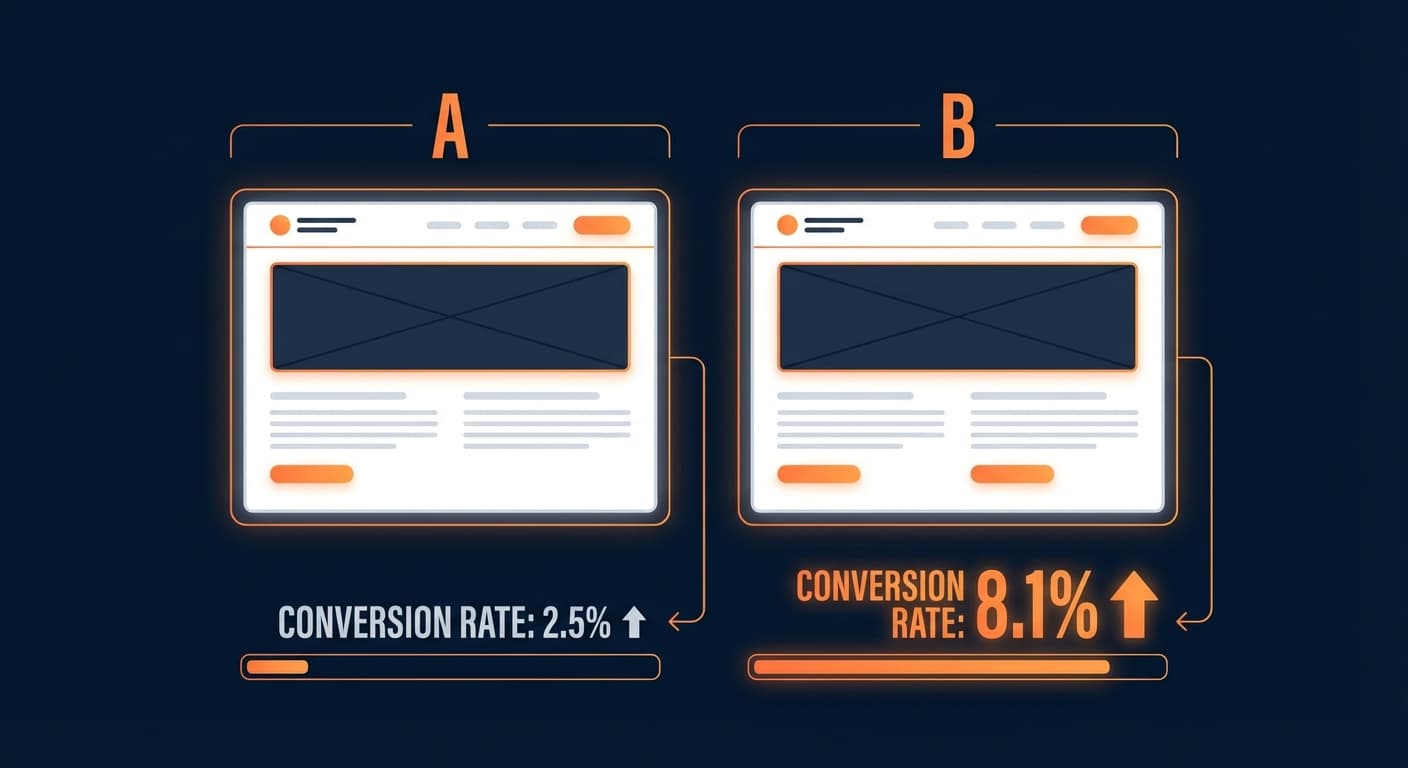
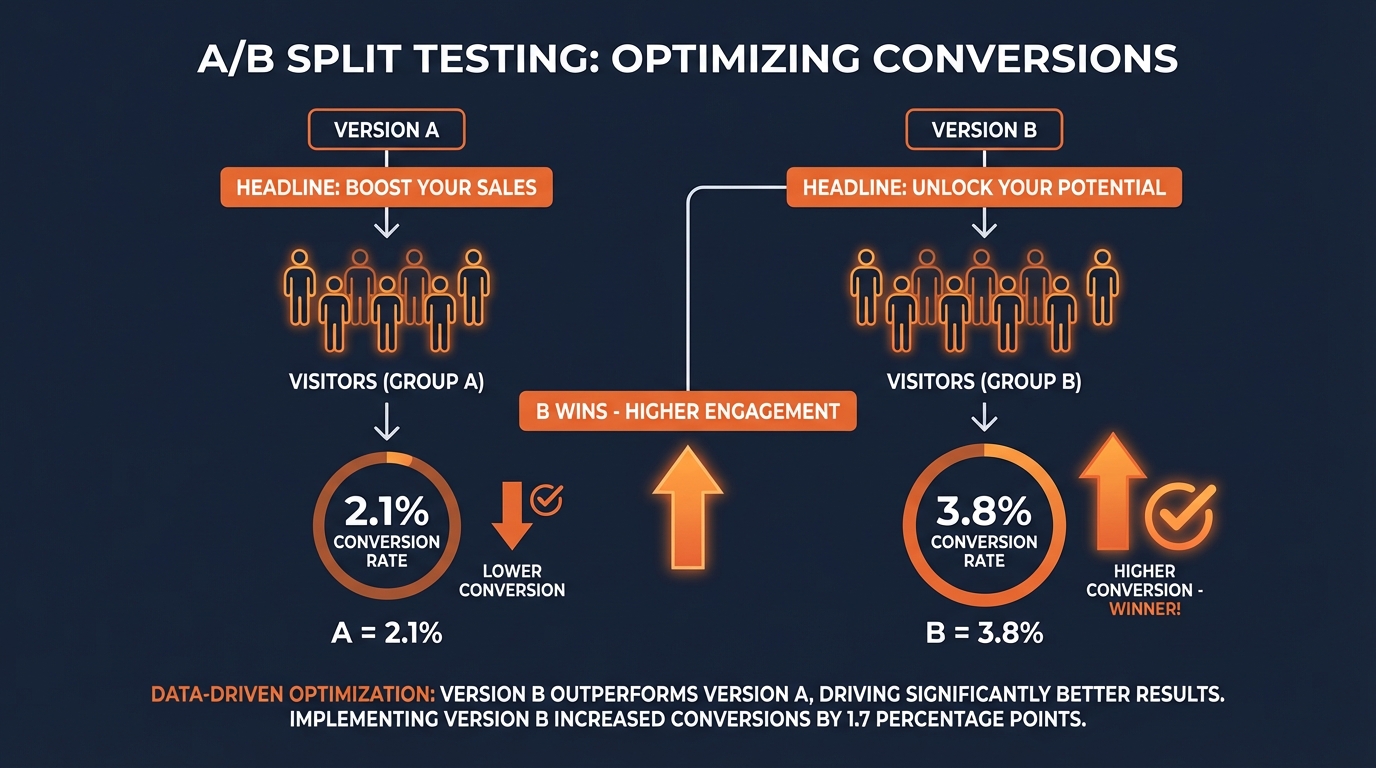
Split-testing - also called A/B testing - is the practice of showing two different versions of something to two different groups of people and measuring which one performs better. Version A goes to half your traffic. Version B goes to the other half. After enough people have seen both, the data tells you which one wins.
That's it. No advanced statistics. No data science degree. Just: which version gets more clicks, more signups, more purchases, or more of whatever outcome you're measuring.
The reason it matters is that human intuition about what works in marketing is reliably terrible. The headline you think is clever? Your audience might find it confusing. The landing page you spent three weeks perfecting? A simpler version might convert twice as well. The email subject line you agonized over? The one you wrote in 30 seconds as a placeholder might outperform it.
You can't predict these things. Nobody can. The only way to know is to test.
And the compounding effect is what makes split-testing genuinely powerful. A 15% improvement on your landing page conversion rate, combined with a 20% improvement on your email open rate, combined with a 10% improvement on your checkout flow, doesn't give you a 45% improvement. It compounds: 1.15 x 1.20 x 1.10 = a 52% improvement in overall performance. From three small tests.
That's not a marginal gain. That's the difference between a $500K business and a $760K business, from the same traffic and the same ad spend. (This is the "Increase Conversion" phase of the SOLID framework - the step most businesses skip entirely.)
I'll give you a real example of what this looks like at scale. I worked with Derek Emery, whose company was doing about $40 million a year. Their main landing page was converting at 18%. We tested one alternative version. The winner hit 36% - doubled the conversion rate. Same traffic, same ad spend, same offer. That single test doubled their leads overnight without spending another dollar on advertising. Over the following months, Derek's company grew to about $55 million. Not from a new marketing channel. Not from a bigger ad budget. From optimizing what was already there, starting with one test on one page.
You don't need a $40 million business for this to matter. The math works the same at every level. If your landing page converts at 2% and a test moves it to 3%, you just got 50% more leads for free. If that means two extra clients a month at $3,000 each, one split test is worth $72,000 a year.
Why Most Small Businesses Don't Test (And Why Those Reasons Are Wrong)
If split-testing is this powerful, why aren't you doing it? Probably one of these reasons:
"I don't have enough traffic." This is the most common excuse and it's partially valid - you do need enough visitors for results to be statistically meaningful. But "enough" is lower than most people think. If your landing page gets 500 visitors a month, you can run a meaningful test in 4-6 weeks. If it gets 1,000, you can get results in 2-3 weeks. You don't need enterprise-level traffic. You need patience.
"The tools are too expensive or complicated." This used to be true. Enterprise split-testing platforms run $300-500/month and require a developer to implement. But simpler options exist now - some free, some cheap, and some built specifically for small businesses without technical teams. The barrier to entry has dropped dramatically. The perception just hasn't caught up.
"I don't know what to test." This is actually the easiest problem to solve. You test the things closest to the money first - the pages and emails that directly influence whether someone becomes a customer. I'll give you a specific priority list below.
"I'm too busy to set up tests." Setting up a basic split-test takes 15-30 minutes once you have the right tool in place. Running the test takes zero of your time - it runs automatically while you do everything else. Reviewing results takes 5 minutes. Total time investment for a test that could increase your revenue by 10-20%: less than an hour.
None of these are real barriers. They're just unfamiliar territory. And unfamiliar territory feels harder than it actually is.
What to Test First (A Priority Framework)
Don't test everything at once. Don't test random things. Test strategically, starting with the elements closest to the money and working outward.
Priority 1: The page with the most traffic and the clearest conversion goal.
For most businesses, this is either your homepage, your main service page, or your pricing page. Whichever page gets the most visitors and has a clear action you want people to take (book a call, sign up, buy something) - that's your first test.
What to test on this page: the headline. Not the body copy, not the images, not the layout. Just the headline. Headlines have the single largest impact on conversion rates of any element on a page. A better headline can improve conversion by 20-50% on its own. Test two versions: your current headline against one alternative. Run it for 2-4 weeks. See which one wins. Keep the winner.
Priority 2: Your email subject lines.
If you send regular emails to your list - newsletters, promotions, sequences - you're leaving money on the table by not testing subject lines. Most email platforms have built-in A/B testing for subject lines. It takes 60 seconds to set up.
Send version A of your subject line to 25% of your list. Send version B to another 25%. Wait 2 hours. Whichever has a higher open rate gets sent to the remaining 50%.
Do this for every email you send. Over 10 emails, you'll have a clear picture of what language, formats, and approaches your audience responds to. That knowledge compounds - every future email benefits from what you learned.
Priority 3: Your call-to-action buttons.
The text on your buttons matters more than you think. "Get Started" performs differently than "Book a Free Call" which performs differently than "See Pricing" which performs differently than "Join Now." The color, size, and placement also matter.
Test one element at a time. Start with the button text on your highest-traffic page. Then test the color. Then test the placement. Each test teaches you something specific about what your audience responds to.
Priority 4: Your pricing presentation.
Not your actual prices (yet) - how you present them. Do you show three tiers or two? Do you highlight the middle tier or the top tier? Do you show monthly pricing or annual? Do you include a comparison table or just list features? Do you anchor with a higher number first?
Small changes in pricing presentation can produce significant shifts in which tier people choose and whether they buy at all. This is high-leverage testing because it directly affects revenue per customer.
Priority 5: Your follow-up sequence.
Test the timing of your follow-up emails (1 day vs. 3 days after inquiry). Test the content (case study vs. testimonial vs. direct pitch). Test the number of touchpoints (3-email sequence vs. 5-email sequence). Follow-up is where most leads die, so even small improvements here have outsized impact.
How to Run Your First Test This Week
Here's a step-by-step process to get your first split-test running in the next 7 days. No developer required. No expensive tools.
1. Pick your page.
Choose the page on your website that gets the most traffic and has a clear conversion goal. Check your analytics to find it. If you don't have analytics set up, this is a sign of a bigger problem - but for now, pick your homepage or your main service page as a starting point.
2. Write one alternative headline.
Look at your current headline. Now write one alternative that takes a different angle. If your current headline is benefit-focused ("Save 10 Hours a Week"), try a pain-focused alternative ("Stop Wasting 10 Hours a Week on Tasks Your Team Could Handle"). If your current headline is specific, try a broader version. If it's broad, try something more specific.
Don't overthink this. You're not trying to write the perfect headline. You're trying to find out if something different performs better than what you have. Even a "worse" headline teaches you something about your audience.
3. Set up the test.
If your website platform has built-in A/B testing (many do), use it. If not, there are free and low-cost tools that add split-testing to any website with a simple code snippet. Google Optimize was the go-to for years - it's been sunset, but alternatives like VWO's free plan, or simple tools designed for small businesses, work fine for a basic headline test.
Set the traffic split to 50/50. Set your conversion goal (button clicks, form submissions, whatever action you want people to take on that page). Launch it.
4. Wait. Don't check it obsessively.
This is the hardest part. Let the test run for at least 2 weeks, or until at least 200 people have seen each version. Don't peek at results after 3 days and make a decision - small sample sizes lie. Set a calendar reminder for the end date and leave it alone until then.
5. Read the results and act on them.
After the test period, check which version had a higher conversion rate. If the difference is 10% or more, you have a meaningful winner. Implement the winning version permanently. If the difference is less than 5%, the test was inconclusive - neither version is clearly better. Try a more dramatically different alternative next time.
Then immediately set up your next test. Testing is not a one-time event. It's an ongoing practice that compounds. Businesses that test continuously - even just one test per month - outperform businesses that test occasionally by a wide margin, because every test builds on the knowledge from the last.
The Mindset Shift That Makes Testing Work
Here's something that trips up a lot of first-time testers: you need to be genuinely okay with being wrong.
If you test your headline and the version you liked less wins, that's a good outcome. The data just told you something your instinct couldn't. If your beautifully designed pricing page loses to a simpler version, that's money found, not ego lost.
The entrepreneurs who get the most from testing are the ones who stop treating their marketing decisions as reflections of their intelligence and start treating them as hypotheses to be validated. "I think this headline is better" becomes "let's find out." That shift - from guessing to knowing - changes how you approach every decision in your marketing. (It also requires the same mindset as shipping imperfect work - you have to be willing to put something live before it feels "ready.")
And once you see the revenue impact of one successful test, you'll never go back to guessing. The data becomes addictive in the best way possible.
Testing Alone vs. Testing With Support
If you've read this far and you're ready to run your first test - do it. This week. Follow the five steps above and see what happens. The worst-case outcome is that you learn something about your audience. The best-case outcome is that you find a 20% improvement in conversion that increases your revenue for months or years.
Where most people get stuck is the technical setup and the analysis. "Is 200 visitors enough?" "Is this result statistically significant?" "My test showed a 7% improvement - is that real or random?" "The tool isn't tracking conversions correctly - how do I fix it?" These are the questions that turn a 30-minute setup into a 3-hour troubleshooting session and a test that never quite runs right.
We built a split-testing tool specifically for Implementation Club members. No enterprise complexity. No $300/month subscription. No developer needed for implementation. You pick what you want to test, set it up in minutes, and get clear results that tell you what's actually working - not a dashboard full of statistical jargon that requires a data science degree to interpret.
Between the tool and the Slack community - where members share their test results, help each other set up experiments, and celebrate wins when a test produces a meaningful lift - testing stops being something you "should be doing" and becomes something you actually do consistently. On Thursdays, we regularly help members design and launch tests together, troubleshoot tracking issues, and interpret results so the next test is even better.
If you've been guessing about what works in your marketing, there's a better way. And once you start knowing instead of guessing, you'll wonder why you waited so long.

Jon Barrett
Jon Barrett is the founder of Implementation Club — a community for entrepreneurs who are done planning and ready to build. He's spent 20+ years building operational systems for businesses of every size, and now helps owners implement faster, get unstuck in real-time, and finally build the business they've been describing to people for years.