
systems
Stop Saying "I Need to Delegate More" and Actually Do It (A System That Works)
You've said it a hundred times. In conversations with your spouse. In your own head at 11 PM. In that mastermind meeting where everyone agreed they need to "delegate more."
"I need to delegate more."
And then Monday came and you did your team's work anyway.
Not because you're a control freak. Not because your team is incompetent. Because in the moment, doing it yourself is genuinely faster. Explaining how you want the proposal formatted takes 20 minutes. Doing it yourself takes 10. Teaching someone your follow-up process takes an hour. Just handling it takes 15 minutes.
So you handle it. Every time. And you've been handling it for so long that your team has learned the most rational lesson possible: wait for the boss to do it.
You don't have a delegation problem. You have a systems problem. And until you fix the system, no amount of "I need to let go" self-talk will change anything.
Why Delegation Fails (And It's Not What the Books Tell You)
Every business book says the same thing: delegate tasks that are below your pay grade. Focus on your zone of genius. Empower your team.
Great advice. Completely useless without a mechanism to execute it.
Here's what actually happens when most entrepreneurs try to delegate:
They hand off a task with verbal instructions. The team member does it differently than expected. The entrepreneur fixes it themselves - sometimes without even telling the team member. They conclude "it's faster if I just do it myself." The task goes back on the owner's plate permanently.
Or this version: they hand off a task, the team member does it adequately but not to the owner's standard. The owner redoes it at midnight. The team member never knows their work was replaced. They keep doing it the same way. The owner keeps redoing it. Both people are now spending time on the same task and only one version ships.
Or the worst version: they hand off a task and step away. The team member has a question but doesn't want to bother the boss. They guess. They guess wrong. Something goes out to a client with an error. The owner discovers it, panics, and takes the task back permanently while adding "I can never trust anyone to do this right" to their internal narrative.
None of these are delegation failures. They're documentation failures. The task wasn't defined clearly enough for someone else to execute it to the owner's standard. And without that definition, delegation is just a polite word for abandonment. (This is what I mean when I say everything is a systems issue, not a people issue. The team member didn't fail. The system did.)
Delegation Without Documentation Is Just Abandonment
This is the insight that changes everything: you cannot delegate what you haven't documented.
When a task lives only in your head - with all its unstated preferences, hidden quality standards, and "obviously you would do X" assumptions - handing it to someone else is setting them up to fail. They don't have access to your mental model. They can't read your mind about what "good" looks like. And when they inevitably do it differently than you would, you blame them for not meeting standards that were never communicated.
The fix isn't "learn to let go." The fix is making the invisible visible. Writing down, step by step, how the task should be done. Not every task in your business - just the ones you want off your plate. (If you want a complete methodology for building documented processes from scratch, I created the DOOR System for exactly that. What you're reading here is the delegation piece - DOOR covers the full lifecycle from brain dump to automation.)
This isn't exciting work. It's not the kind of thing that makes a good LinkedIn post. But it's the difference between "I tried delegating and it didn't work" and "my team handles this without me now."
The Delegation System: Five Steps to Actually Hand Things Off
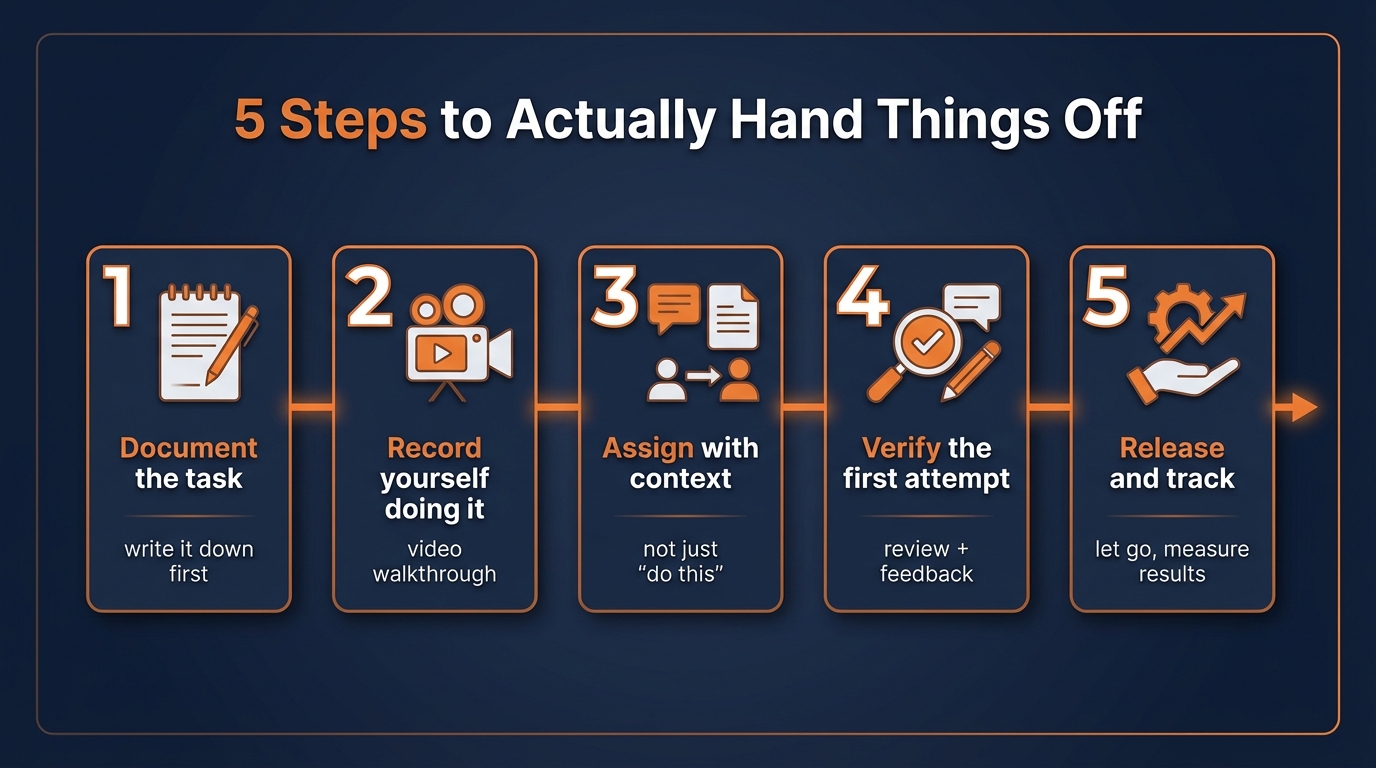
Here's a practical system for moving tasks off your plate permanently. Not theoretically. Actually.
Step 1: Identify your "Delegation Candidates" - the tasks that should have left your plate months ago.
For one week, keep a running list of every task you complete. At the end of the week, mark each one with a simple filter:
"Green" - Only I can do this. It requires my specific expertise, relationships, or authority. Truly cannot be done by anyone else.
"Yellow" - I do this because I'm the best at it, but someone else could learn. It would take training, but the task itself isn't uniquely mine.
"Red" - There is absolutely no reason I should be doing this. It's administrative, repetitive, or straightforward enough that anyone with basic training could handle it.
Most entrepreneurs find that 20-30% of their tasks are Red and another 30-40% are Yellow. That's 50-70% of your weekly work that could be on someone else's plate with the right documentation and handoff.
Start with the Red tasks. Those are your immediate delegation candidates.
Step 2: Pick ONE task and document it. Right now.
Not all the Red tasks. One. Pick the one that's most repetitive - the thing you do every week (or every day) that follows roughly the same steps each time.
Now document it. Here's the format that works:
Task name: What is this task? (e.g., "Send weekly client report")
Trigger: What tells you it's time to do this? (e.g., "Every Monday morning" or "When a new client signs the contract")
Steps: What do you actually do, in order? Number each step. Be embarrassingly specific. Don't write "format the report." Write "Open the report template in Google Docs. Duplicate it. Rename the duplicate with the client name and today's date. Pull this month's data from the analytics dashboard - specifically the sessions, conversions, and revenue numbers from the Overview tab."
Quality check: What does "done right" look like? (e.g., "All numbers match the dashboard. Client name is spelled correctly. PDF is attached, not a link. Sent before 10 AM.")
Common mistakes: What could go wrong? (e.g., "Sometimes the dashboard shows last month's data if the filter isn't reset. Always check the date range before pulling numbers.")
Who to ask if stuck: Who should they contact if something doesn't look right?
This document doesn't need to be perfect. It needs to be complete enough that a smart person who's never done this task before could follow it and produce an acceptable result on their first attempt. If it doesn't meet that bar, it's not ready to hand off.
Step 3: Hand it off with a "Watch me, do it with me, do it alone" sequence.
Don't just email the document and say "here you go." Use a three-step handoff that dramatically increases the odds of a clean transfer.
Session 1 - "Watch me." Do the task yourself while your team member watches and follows along with the document. Let them ask questions. Note anything the document missed that you do automatically without thinking about it. Update the document.
Session 2 - "Do it with me." Your team member does the task while you watch. Don't take over when they hesitate. Let them reference the document. Answer questions. Note where they get stuck - those spots need clearer documentation.
Session 3 - "Do it alone." Your team member does the task independently. They submit it to you for review - not for you to redo, but for you to verify it meets the quality check criteria. Give specific feedback: "This was right. This needed to be different - here's why."
After three cycles, most tasks transfer cleanly. The team member owns it. You review it occasionally but don't do it.
Step 4: Accept "80% of your way" as a win.
This is where most entrepreneurs sabotage their own delegation. The team member does the task. It's correct. It meets all the quality criteria. But it's not exactly how you would have done it. The formatting is slightly different. The email is worded differently than you'd word it. The report has the right numbers but the layout isn't what you'd choose.
Let it go.
If the task meets the quality check criteria you defined in the documentation, it's done. The 20% difference between "their way" and "your way" is not worth the hours you'd spend redoing it. Your standards need to be clear and measurable ("numbers are accurate, sent before 10 AM") not subjective and impossible ("it should feel the way I would do it").
The goal isn't to clone yourself. The goal is to remove tasks from your plate so you can focus on the work that only you can do. An 80% version of your approach, done by someone else, is infinitely better than a 100% version done by you at 11 PM when you should be with your family.
Step 5: Build a "Delegation Library" - one document at a time.
Every time you document and hand off a task, add that document to a central location your team can access. Google Drive folder, Notion workspace, shared document - the format doesn't matter. What matters is that it exists and grows over time.
Within 60-90 days of documenting one task per week, you'll have 8-12 documented processes. That's 8-12 tasks permanently off your plate. More importantly, you'll have the beginning of an operations manual for your business - the thing that lets your team operate independently and lets you step away without everything falling apart.
Each new document makes the next one easier to write because you get faster at the format. And each handoff builds your team's confidence that they can handle more. The flywheel starts slow and accelerates.
I helped Michael Snider build documented systems for his marketing, follow-up, and operations. Within eight months, he went from doing everything himself to managing three team members - and the systems I'd helped him create were clear enough that his team could execute without constant oversight. His business was generating leads on autopilot through the systems while he focused on the work only he could do. That didn't happen because he found three amazing people. It happened because the delegation library was solid enough that good people could follow it and produce good results.
The Task You Should Delegate First
If you're not sure where to start, delegate this one: the task you do most frequently that you secretly resent.
You know which one it is. It's the thing that shows up on your plate every week and makes you think "why am I still doing this?" It's not complex. It's not strategic. It's just... there. Taking 30-60 minutes of your time every single week because nobody else has been set up to handle it.
That's your first delegation candidate. Document it this week. Hand it off next week. Reclaim that hour permanently.
One hour per week doesn't sound like much. It's 52 hours per year. That's more than a full work week you get back from a single delegation. And it's the proof of concept that makes the second delegation easier, and the third, and the tenth. (If you want to see where all your hours are actually going before you decide what to delegate, start with the time audit in this article.)
The Bridge From Theory to Done
These five steps work. The system is straightforward. And if you sit down this week and document one task using the format above, you'll have made more progress on delegation than the last year of telling yourself you "need to delegate more."
But here's what typically happens: you document one task, hand it off, and it goes well. Then life gets busy. The second task doesn't get documented. The third never starts. The Delegation Library stays at one document because creating the documentation takes focused time you don't have - which is the exact problem delegation was supposed to solve.
It's a catch-22: you need to spend time building systems to save time, but you don't have the time to build the systems.
This is where doing it alongside someone else makes a material difference. In the Implementation Club, we build SOPs and delegation systems together during Thursday sessions. You bring the task you want off your plate. We help you document it in the format that works. You walk out with a finished handoff document - not a plan to write one someday.
Between sessions, the Slack community is full of business owners sharing their delegation documents, troubleshooting handoff problems, and pushing each other to keep building their libraries. When your team member does the task wrong and you want to take it back, you've got a community that says "don't - fix the document instead."
Building a delegation system alone is possible. Building one with support, accountability, and people who've already done it is faster, more consistent, and far more likely to actually stick.

Jon Barrett
Jon Barrett is the founder of Implementation Club — a community for entrepreneurs who are done planning and ready to build. He's spent 20+ years building operational systems for businesses of every size, and now helps owners implement faster, get unstuck in real-time, and finally build the business they've been describing to people for years.